
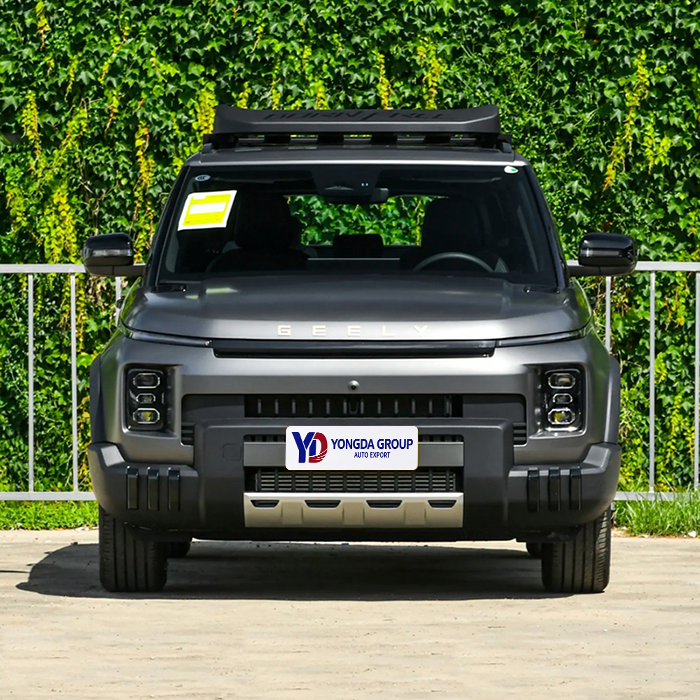

2026 Geely Cowboy 1.5TD Explore Edition — New LHD Compact SUV for African Importers
The 2026 Geely Cowboy is a 4,442 mm five-seat compact SUV built on Geely's BMA global modular architecture, with a 1,499 cc four-cylinder turbocharged engine, a seven-speed wet dual-clutch transmission and four-wheel independent suspension. The Explore Edition adds Level 2 driver assistance, a full-LCD instrument cluster and a 256-colour ambient lighting system. Left-hand drive, brand-new unregistered units, exported from China with complete documentation.
Trust bar: New cars only · Left-hand drive · Batch orders and spare-parts co-loading · Documented pre-shipment inspection
Why the Geely Cowboy Fits African Operating Conditions
Most compact SUVs sold into Africa were engineered for smooth motorways and temperate weather. Three of this vehicle's documented characteristics map onto different conditions, and they are the reasons it is worth a line on your order sheet.
The torque arrives low. Peak torque of 290 N·m is available from 2,000 rpm and holds through 3,500 rpm. That is the band a loaded car actually uses: pulling away on an incline with five passengers, the air conditioning running and the boot full. An engine that has to be revved to make its power is the wrong engine for that job, and the Cowboy's 1,499 cc four-cylinder turbo is not that engine. It is a four-cylinder, not a three-cylinder — a point that matters to buyers in this market, who associate three-cylinder engines with vibration and short service life and say so at the counter
The fuel is ordinary. The engine is specified for 92-octane petrol, so it does not depend on a premium grade that may not exist at the pump you reach next. Combined consumption is 6.97 litres per 100 km on the WLTC cycle from a 51-litre tank — which calculates to roughly 730 km between fills, a figure that matters on intercity routes where the distance between reliable stations is longer than the range of a thirsty car
The displacement sits under the brackets. At 1,499 cc the Cowboy falls inside the 1,800 cm³ ceiling that Algeria applies to petrol passenger vehicles under its import allowance framework, and under the displacement thresholds that several other African markets use to band import duty and annual circulation tax. For a dealer building a duty-optimised line, displacement is not an engineering footnote, it is the first line of the landed-cost calculation
What ties these together is the platform. The BMA architecture is the global modular base Geely uses across its export range, not a domestic-market one-off. That matters downstream, when the car is in a workshop 8,000 km from the factory and a technician is looking for a part number.
Powertrain: 1.5TD and the 7-Speed Wet Dual-Clutch
| Specification | Figure |
| Engine code | BHE15-EFZ |
| Displacement | 1,499 cc |
| Configuration | Configuration |
| Induction and fuelling | Turbocharged, direct injection, DVVT |
| Maximum power | 133 kW / 181 PS @ 5,500 rpm |
| Maximum net power | 128 kW |
| Maximum torque | 290 N·m @ 2,000–3,500 rpm |
| Transmission | 7-speed wet dual-clutch (DCT) |
| Drive layout | Front-wheel drive |
| Top speed | 200 km/h |
| Fuel | 92-octane petrol |
| Fuel consumption, WLTC combined | 6.97 L/100 km |
| Fuel tank | 51 litres |
| Emission standard | China VI b |
This is a front-wheel-drive vehicle. There is no four-wheel-drive variant in the range. It is a light-off-road and rough-road vehicle, not a 4x4, and the sales conversation has to be set up that way from the first message. Buyers who need genuine all-wheel traction for sand, mud or steep loose gradients are not this vehicle's customer, and telling them so protects your margin and your reputation.
Acceleration figures are not published by the manufacturer. We do not print a 0–100 km/h number, because none has been released for this build. If you need it for a specification sheet, obtain it in writing from the supplier.
Top speed of 200 km/h is the manufacturer's figure. It is irrelevant to most buyers in this market; we include it only because it is documented.
Rough-Road Geometry and Ride Comfort
The Cowboy's chassis specification is its strongest commercial argument, because it is the area where this vehicle does not behave like a cheap car.
Both axles are independent. The front uses MacPherson struts; the rear uses a multi-link arrangement. In this price bracket the default rear suspension is a torsion beam, and the difference is felt on exactly the surfaces your customers drive on: broken tarmac, patched tarmac, graded dirt and the transition between all three. Geely fits RS-valve dampers — a valve construction normally found on more expensive vehicles — and tunes them for a more linear response over irregular ground.
The body's terrain geometry is documented: an approach angle of 19° and a departure angle of 24°. Those two figures, plus a 1,770 mm body height and the optional factory all-terrain tyre package, are what the rough-road capability claim rests on. Hill Descent Control and Hill-start Assist are fitted across the range, so a loaded car on a steep descent is controlled by the vehicle rather than by the driver's left foot.
| Chassis item | Specification |
| Front suspension | MacPherson independent, RS-valve dampers |
| Rear suspension | Multi-link independent |
| Brakes, front / rear | Ventilated disc / solid disc |
| Parking brake | Electric parking brake with Auto Hold |
| Steering | Electric power assistance, three-level assistance adjustment on Explore Edition |
| Standard wheels and tyres | 18-inch alloy, 215/55 R18 |
| Optional off-road pack | 17-inch wheels, 17-inch all-terrain tyres, red brake calipers |
| Spare wheel | Non-full-size spare, stowed in the boot (Explore Edition) |
| Approach angle / departure angle | 19° / 24° |
| Kerb weight | 1,395 kg |
| Gross vehicle weight | 1,815 kg |
| Calculated payload | 420 kg |
On payload. The 420 kg figure is arithmetic from the two published weights, not a manufacturer claim. It is a useful number for fleet buyers who need to know whether the car carries what the job requires, and it is honest to present it as a calculation. Do not upgrade it into a headline claim.
Hot-Climate Cabin and Everyday Practicality
Storage is the design feature. The body is 4,442 mm long but the wheelbase is 2,640 mm, which means the car spends its length on cabin rather than on overhangs — Geely's own short-overhang claim, and a claim you can check against the photograph. The manufacturer states that the rear seat accommodates a 1.9 m passenger. Total interior storage is documented at 41 compartments. The rear bench splits 4/6 and folds to extend load space.
Utility options worth ordering. Two factory packages exist and both are relevant to this market:
The roof equipment rack provides a 1.3 m² mounting deck rated to 50 kg — enough for a roof tent, bicycles or trade equipment. It arrives factory-fitted, so it is homologated and insured rather than a dealer bolt-on.
The tailgate storage box opens upward and includes a drainage function with a mesh divider, designed for wet or dusty items — boots, hoses, fishing gear, tools. It keeps wet goods out of the cabin, which in a dusty or rainy season is a daily problem rather than an occasional one.
On the optional glass roof. A fixed panoramic glass roof is available as part of the off-road option package. In high-ambient-temperature markets it raises the cabin heat load and puts more demand on the air conditioning compressor. If your buyers prioritise cooling over appearance, order the vehicle without it. This is a commercial recommendation, not a manufacturer position.
Colours. Warrior Black, Snow White, Jungle Green and Volcanic Grey. The interior is a single specification: black leather-and-suede upholstery with gold stitching and a "BORN FREE" embossed front seat, with grab handles on the passenger side and door panels.
Cockpit, Connectivity and Driver Assistance
The cabin hardware is modern: a 14.6-inch central touchscreen at 1920 x 1080 resolution running Geely's Flyme Auto system on the E02 cockpit platform, paired on the Explore Edition with an 8.8-inch full-LCD instrument cluster. The system supports two-zone voice wake-up with continuous multi-turn recognition, so the driver completes a sequence of commands without repeating the wake phrase. Six speakers, three USB ports (one front, two rear), automatic climate control and rear vents complete the standard equipment list, and a 256-colour ambient lighting system is fitted to the Explore Edition.
Driver assistance on the Explore Edition is Level 2, comprising:
Full-speed adaptive cruise control
Lane-keeping assist and lane-departure warning
Emergency lane-keeping assist
Forward collision warning
Autonomous emergency braking with pedestrian and two-wheeler detection
Intelligent high-beam control
Traffic-sign recognition
Every version of the Cowboy carries a 540° camera system combining a 360° surround view with a transparent-chassis view of the ground beneath the vehicle, plus rear parking sensors. In cities where kerbs are high, lanes are shared with motorcycles and parking is improvised, that camera set earns its place in the specification. Passive safety on the Explore Edition comprises driver and passenger airbags, front side airbags and front-and-rear curtain airbags, secured by electronic stability control, ABS with EBD, brake assist, traction control, emergency stop signalling, speed limiting, tyre-pressure monitoring and ISOFIX child-seat anchorages.
New Cars Compact SUV Gasoline Voiture Neuve Gray/Black Geely Cowboy Car 1.5td Wild /Explore Version


Contact Us | B2B Inquiries Address |
| Office: 2/F, D3 Building, Huazhong CCCC City, Hanyang, Wuhan, Hubei, China |
| |
| Showroom: No.5 Longxiang Rd, Hanyang, Wuhan, Hubei, China |
|


