
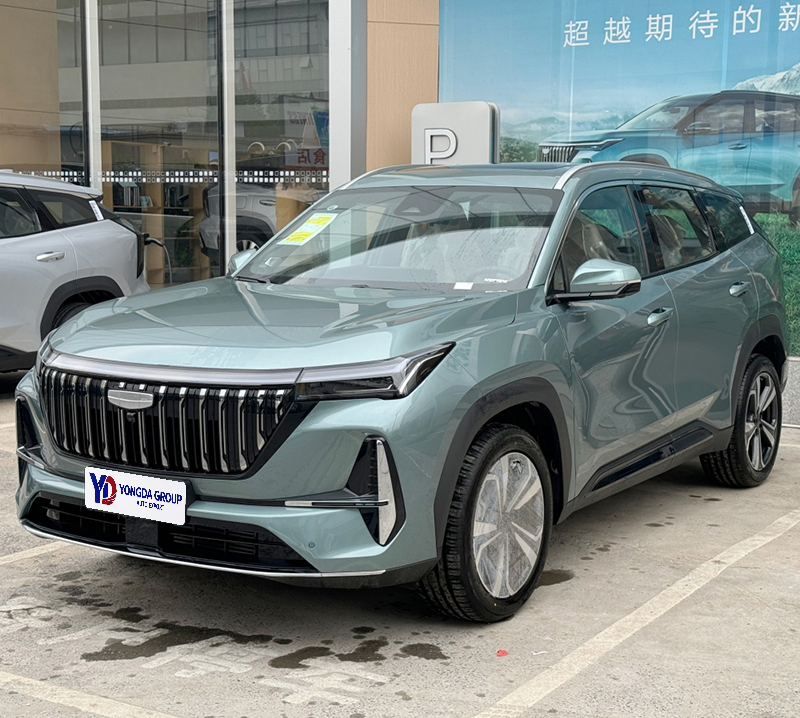
Geely Boyue L SUV — 1.5TD and 2.0TD New Cars for African Importers
Fourth-generation Geely Boyue L: a 4,730 mm compact SUV on a 2,785 mm wheelbase, built on Geely's new-generation CMA architecture, with a 1,499 cc 1.5TD or a 2.0-litre 2.0TD turbo engine and a 7-speed wet dual-clutch transmission. Left-hand drive, brand-new units, exported from China with complete documentation.Trust bar: New cars only · Left-hand drive · Batch orders and spare-parts co-loading · Documented pre-shipment inspection
Why the Geely Boyue L Fits African Market Conditions
The Boyue L is not a converted city car. It is the fourth generation of the compact SUV that made Geely a volume brand, and it sits on the same new-generation CMA architecture and GEEA 3.0 electrical platform that Geely uses across its export-focused global range.
For importers in Algeria, Tunisia, Morocco, Libya and Egypt, the commercial logic is unusually clean. First, it is a petrol-only model — and with Algeria having prohibited diesel passenger-car imports since 2022, a spark-ignition SUV avoids the region's single biggest access barrier. Second, the 1.5TD displaces 1,499 cc, which keeps the vehicle inside the 1,800 cm³ ceiling that Algeria's 2026 finance law applies to the duty-free vehicle import allowance for returning nationals. Third, buyers whose market has no displacement cap can order the 218 PS 2.0TD from the same body, the same platform and the same parts bin. Inside the dealership, that matters more than any single specification: one architecture, one transmission family and one service procedure means far fewer part numbers to stock — which is what actually decides whether an imported SUV stays profitable in year three and four.
That combination — two petrol engine choices spanning the 1,800 cc line, one platform, one service method — is the reason this model earns shelf space in a North African showroom.
1.5TD or 2.0TD? Choosing the Right Powertrain for Your Market
Both engines are turbocharged and both drive through the same 7-speed wet dual-clutch transmission, so the decision is commercial, not mechanical. Match the engine to the duty bracket and the road, not to the brochure
| Specification | 1.5TD | 2.0TD |
| Engine | 1.5 L turbo, direct injection, 4-cylinder | 2.0 L turbo, 4-cylinder |
| Displacement | 1,499 cc | 2.0 L — confirm exact cc on the COC |
| Engine family | BHE15-EFZ, 1.5 L turbo family co-developed with Volvo | JLH-4G20TD family, 2.0 L turbo |
| Maximum power | 133 kW / 181 PS | 160 kW / 218 PS |
| Maximum torque | 290 N·m | 325 N·m |
| Transmission | 7-speed wet dual-clutch (DCT) | 7-speed wet dual-clutch (DCT) |
| Drive | Front-wheel drive | Front-wheel drive |
| Displacement bracket | Inside 1,800 cm³ import schemes | Above 1,800 cm³ |
| Best commercial fit | Duty-sensitive markets, urban fleets, family and taxi use | Fleet and long-route use, buyers with no displacement cap |
Take the 1.5TD when the destination market penalises displacement — Algeria's 1,800 cm³ allowance, Tunisia's steep excise on large petrol engines, or any market where the annual tax bracket steps up with engine size. It is the volume seller of the two, and the difference of 35 N·m is not something a buyer notices in city traffic.
Take the 2.0TD when the destination has no displacement ceiling and the vehicle will run loaded, over long distances or on mountain routes — the extra 35 N·m and 37 PS are exactly the kind of headroom a fleet operator pays for once and then benefits from for the life of the unit.
Order both on the same purchase order if you want a full-range showroom: the two variants share the body, the interior and the service procedure, so the display space and the technician training are the same.
Import-Ready: Displacement, Duty and Documentation
This is the section most export pages skip, and it is the one a serious importer reads first.
Algeria. The 2026 finance law (promulgated 14 December 2025) reset the vehicle import framework, extending the duty-free allowance for returning nationals to vehicles under five years old and, in article 202, limiting that allowance to electric, spark-ignition (petrol) or petrol-electric hybrid passenger vehicles of 1,800 cm³ or less. Diesel passenger cars remain excluded from import under the 2022 prohibition. The commercial consequence for this model is precise: the 1,499 cc 1.5TD falls inside the ceiling, the 2.0-litre 2.0TD does not. If your buyers are diaspora returnees or you are building a duty-optimised line, lead with the 1.5TD.
Morocco. Conventional petrol and diesel passenger vehicles commonly attract customs import duty in the 10–17% band, with the exact rate depending on classification, engine displacement, emissions standards and origin. Morocco also prohibits the import of passenger vehicles older than five years, calculated from first registration in the exporting country — a rule that new-car exports clear automatically, which is one of the structural advantages of selling new stock rather than used stock into Morocco.
Tunisia. Consumption-tax treatment is displacement-sensitive to a degree that changes product mix: reported excise rates reach well into the hundreds of percent for large petrol engines, so the smaller-displacement variant is not a fuel-economy argument in Tunisia, it is a landed-cost argument.
How to trade on this. Ask us for the model-level customs data before you commit to a mix, and we will ship the duty-supported variant for your market rather than the variant with the better headline specification. Import rules in the region are amended annually, so treat the brackets above as a planning baseline and confirm the applicable rate with your customs broker against the actual COC before you price your retail offer. [CONFIRM] which destination markets and which import channel (dealer licence vs. personal allowance) you want quoted, and whether you want us to pre-check each order against the current tariff position.
Space and Practicality for Family and Fleet Duty
A 4,730 mm body on a 2,785 mm wheelbase puts the Boyue L at the large end of the compact-SUV class, and that length is spent where it pays: cabin and load space rather than overhangs. Five adults sit in a two-row layout, with the wheelbase carrying the rear legroom that makes the vehicle usable as a family car, a company pool car or a chauffeured executive car without changing specification.
Practical equipment that carries weight in this market includes an openable panoramic sunroof, keyless entry and keyless start, rear air vents and automatic air conditioning — the combination that keeps a fully occupied cabin comfortable in hot-climate use. Ride height and body width — 1,910 mm — give the stance buyers expect from an SUV rather than a raised hatchback, and the 0.25 Cd drag coefficient is unusually low for the class, which helps at highway speeds where fuel is bought by the tank, not by the litre
Boot volume, luggage geometry and child-restraint anchor points should be confirmed against the actual trim sheet before you publish them; we hold the current figures on the specification sheet supplied with every order. [CONFIRM boot volume, ISOFIX anchor count, kerb weight and ground clearance]
Trim-dependent comfort specification on the upper grades includes heated, ventilated and massage front seats — a useful differentiator when you are competing against a used Japanese SUV at the same retail price point, because the buyer is comparing cabin features, not model years. [CONFIRM which trims in your allocation carry heated, ventilated and massage front seats]
The Cockpit: Flyme Auto, Longying-1 and Driver Assistance
The interior is where the fourth-generation Boyue L separates itself from the used Japanese SUVs it competes against on a North African forecourt, because the comparison a buyer makes is not model year against model year — it is screen and interface quality against a ten-year-old dashboard.
The cockpit runs Geely's Flyme Auto system on a 7 nm automotive-grade Longying-1 chip, which is the part that determines whether the interface still feels immediate after five summers of heat soaking. The system supports continuous voice recognition and "see and speak" control, meaning the driver speaks the command rather than navigating a menu tree — a genuine safety and usability difference in traffic. Reported equipment on the current generation includes a 15.4-inch 2.5K central touchscreen and a 25.6-inch augmented-reality head-up display, with four-zone voice interaction, traffic-light countdown display and navigation projection. [CONFIRM screen size, AR-HUD availability and connectivity feature list per trim for your allocation]
One point to raise with buyers rather than hide: connected services, over-the-air updates and navigation licensing are region-dependent. Confirm with your supplier which connected functions are active, which require a local data plan, and which fall back to offline operation in your market — an importer who promises a connected feature that does not activate in-country loses credibility on the first delivery. We provide the current in-market connectivity statement per destination on request.
Body Structure, Safety Architecture and ADAS
The Boyue L is built on the new-generation CMA architecture, with the GEEA 3.0 electronic and electrical architecture carrying the vehicle's systems. This is the same structural and electrical generation that underpins Geely's global export range, which means the platform's engineering and its diagnostic ecosystem are both supported internationally rather than only in the domestic market.
Geely's current-generation advanced driver assistance package — marketed as Qianli Haohan, with the H3 hardware tier shown on the "Little Blue Light" edition of this model — brings the driver-assistance functions that fleet buyers now put in a tender specification: adaptive cruising, lane-keeping support and autonomous emergency braking among them. [CONFIRM which ADAS tier, camera count and sensor set the units in your allocation carry, and which functions are activated in the destination market]
On crash-test ratings and safety claims, we publish only what the documentation supports. Independent crash-test results, airbag count and structural material specifications vary by market version, and we will state the applicable rating for your build order on request rather than quote a figure that belongs to a different specification. [CONFIRM the applicable crash-test result and airbag count for the LHD export build]
Supply, Shipping and Documentation
We supply this model as a complete export package rather than a car on a quay. Every order is handled as follows.
Allocation and build. Units are ordered against your trim mix, colour mix and destination market, with the order confirmed in writing before the factory slot is booked. New cars only — no ex-demo or repainted stock, and the VIN list for your allocation is issued to you before loading so that you can pre-sell against real chassis numbers, which is how a dealer locks in a retail price with confidence. [CONFIRM allocation lead time and deposit terms]
Container loading and co-loading. The Boyue L loads into standard containers as a finished vehicle; loading plans, spacing method and units per 40HQ container are issued per order. [CONFIRM units per 40HQ] Spare parts, accessories and consumables can be co-loaded in the same shipment as the vehicles, which removes an entire separate freight cost from your first-year parts stocking — and the ability to order a service kit alongside the first cars is often the difference between a dealer being able to service what it sells and having to turn work away.
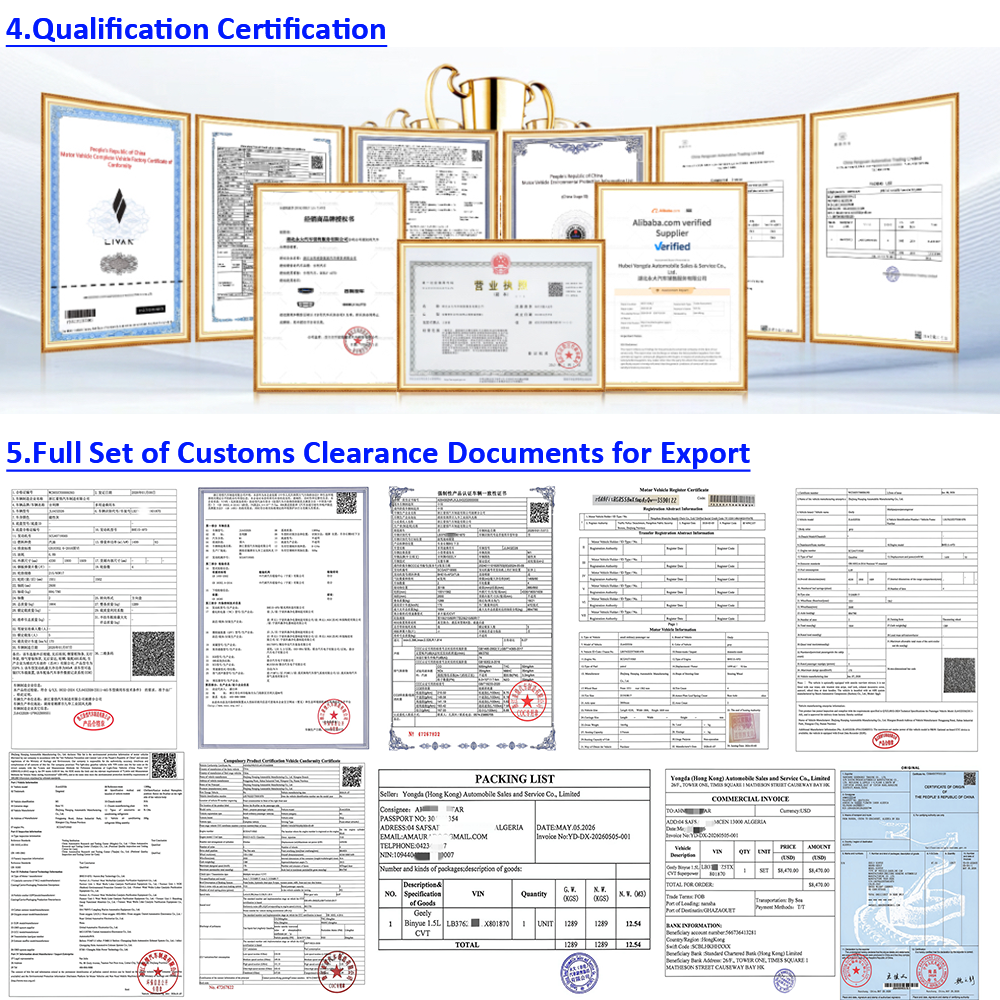
Documents supplied with every shipment: commercial invoice, packing list, Bill of Lading, certificate of origin, and the Certificat of Conformity documentation applicable to the destination. [CONFIRM which destination-specific certificates (COC, E-mark, emissions certification, SONCAP-type pre-shipment inspection) your market requires and whether they are included in the quoted price or charged separately]
Photographs and inspection. Pre-shipment photographs of each unit at the loading yard, a quality sheet and a copy of the inspection record travel with the shipping documents, so that what arrives at the port matches what was invoiced.
New Cars Export Geely Boyue L Suv 2.0TD 1.5TD Boyue l Geely Starray 2026 2025 2023 RORO Certificate of Origin Ground Clearance


Contact Us | B2B Inquiries Address |
| Office: 2/F, D3 Building, Huazhong CCCC City, Hanyang, Wuhan, Hubei, China |
| |
| Showroom: No.5 Longxiang Rd, Hanyang, Wuhan, Hubei, China |
|


